Brescia-Cremona
Distanza
64 km
Durata
about 3 hours
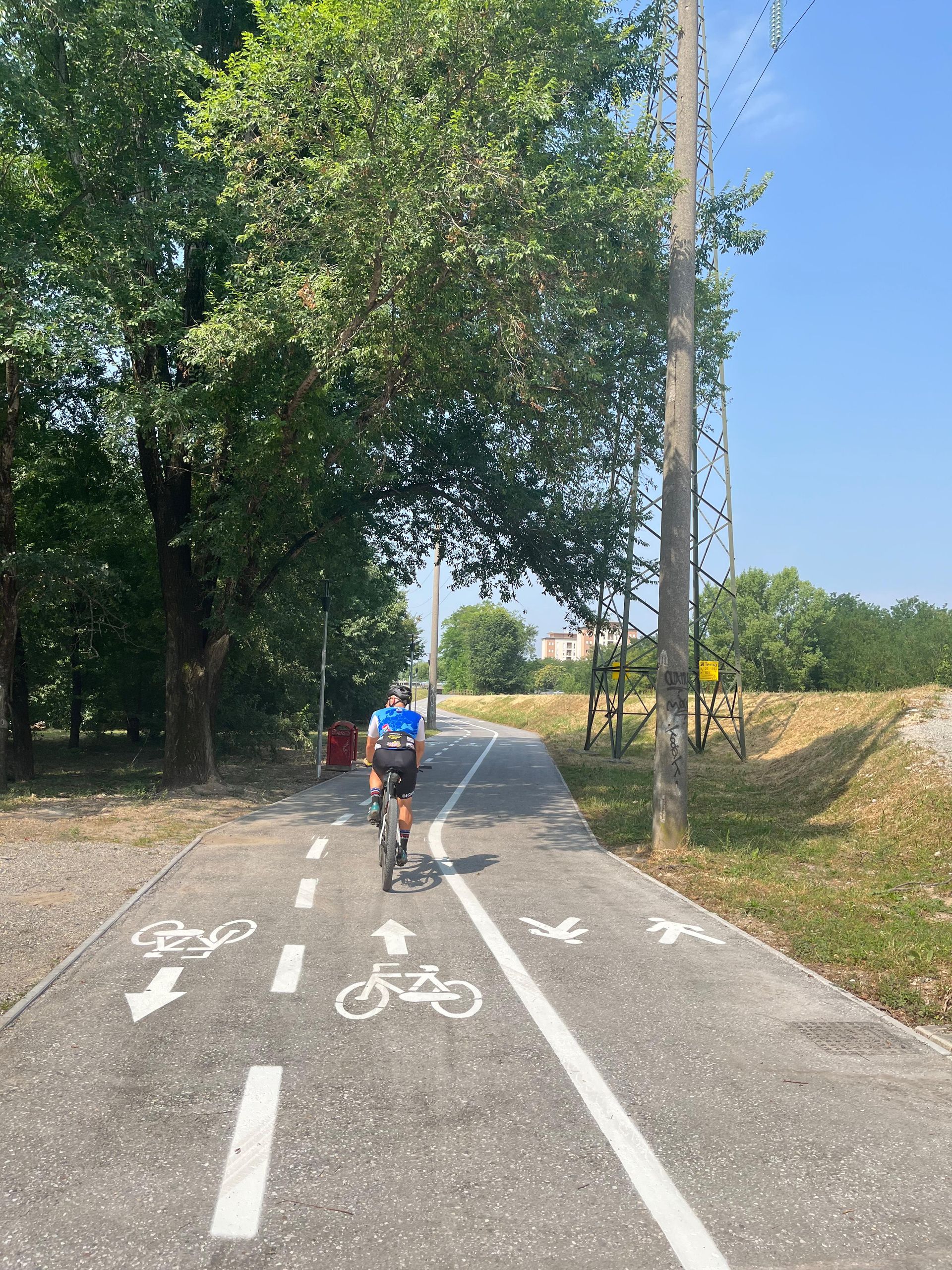
The Brescia–Cremona cycle path connects two Lombard art cities over approximately 64 km, crossing the Bassa Bresciana among agricultural parks, rural villages, and the Oglio River.
A route that is almost entirely flat, on a mixed surface of asphalt and dirt, suitable for city bikes, touring bikes, and gravel bikes.
It moves through the territory of the ancient Brixiana road, the Roman road that connected Cremona to Brescia, and the Brescia–Cremona railway offers the possibility to shorten the route (Robecco-Pontevico station).
Brescia
Brescia is the starting point, with the cycle path that branches off from the area of the train station: a city of art, home to the Pirlo, the typical Brescian aperitif, which is worth a visit before getting on the bike.
Dominated by its majestic Castle, the historic center of Brescia is reachable with a simple and pleasant ride directly from the Train Station. The route takes cyclists into the monumental heart of the city, unfolding in its elegant historic squares, such as Piazza della Loggia and Piazza Paolo VI with the Cathedrals, up to the extraordinary UNESCO heritage of Roman Brescia with the Capitolium and the monastic complex of San Salvatore and Santa Giulia.
To move around the city in perfect intermodality the subway, in some of whose stations you can admire the contemporary artworks of the permanent exhibition SUBBRIXIA. By using a regular travel ticket, it is possible to bring a traditional bicycle on board for free (electric scooters and pedal-assisted bicycles are not allowed).
Monte Netto Park and Capriano del Colle
Leaving the outskirts of Brescia, the cycle path enters the Local Park of Supramunicipal Interest (PLIS) of Monte Netto, a hill between the municipalities of Capriano del Colle, Poncarale, and Flero.
An oasis of fields and historic farmhouses that have preserved the charm of rural life, with a part of the park marked in the past by gravel extraction activities.
In Capriano del Colle, the park's visitor center is located.
Offlaga and the Bassa Bresciana
Beyond Capriano del Colle, passing through Offlaga, the landscape becomes typical of the Bassa bresciana: cultivated plains, farmhouses, and low-traffic country roads.
The route favors secondary roads that are almost traffic-free.
An ideal stretch for cycling slowly while observing the irrigation channels and crops of the Brescia countryside.
Verolanuova
Not far from the route, Verolanuova is a pleasant detour from the cycle path to visit the Basilica of San Lorenzo, featuring two imposing paintings by Giambattista Tiepolo (The Fall of Manna and The Sacrifice of Melchizedek).
Pontevico and Strone River Park
Pontevico is the final stop of the Brescia section of the itinerary and takes its name from the bridge over the Oglio crossed by the Brixiana road.
The Strone River Park, a path of about 4 km through fields and vineyards and along a small canal, guides cyclists through the most picturesque and naturalistic part of the route.
The Castle of Pontevico overlooks the town, while the Hammer Museum houses an ancient forge that remained active for over a century.
From here, one crosses the Oglio, leaving the province of Brescia.