AIDA (High Italy to Cross)
Distanza
75 km
Durata
about 4 hours
Dislivello
400 m
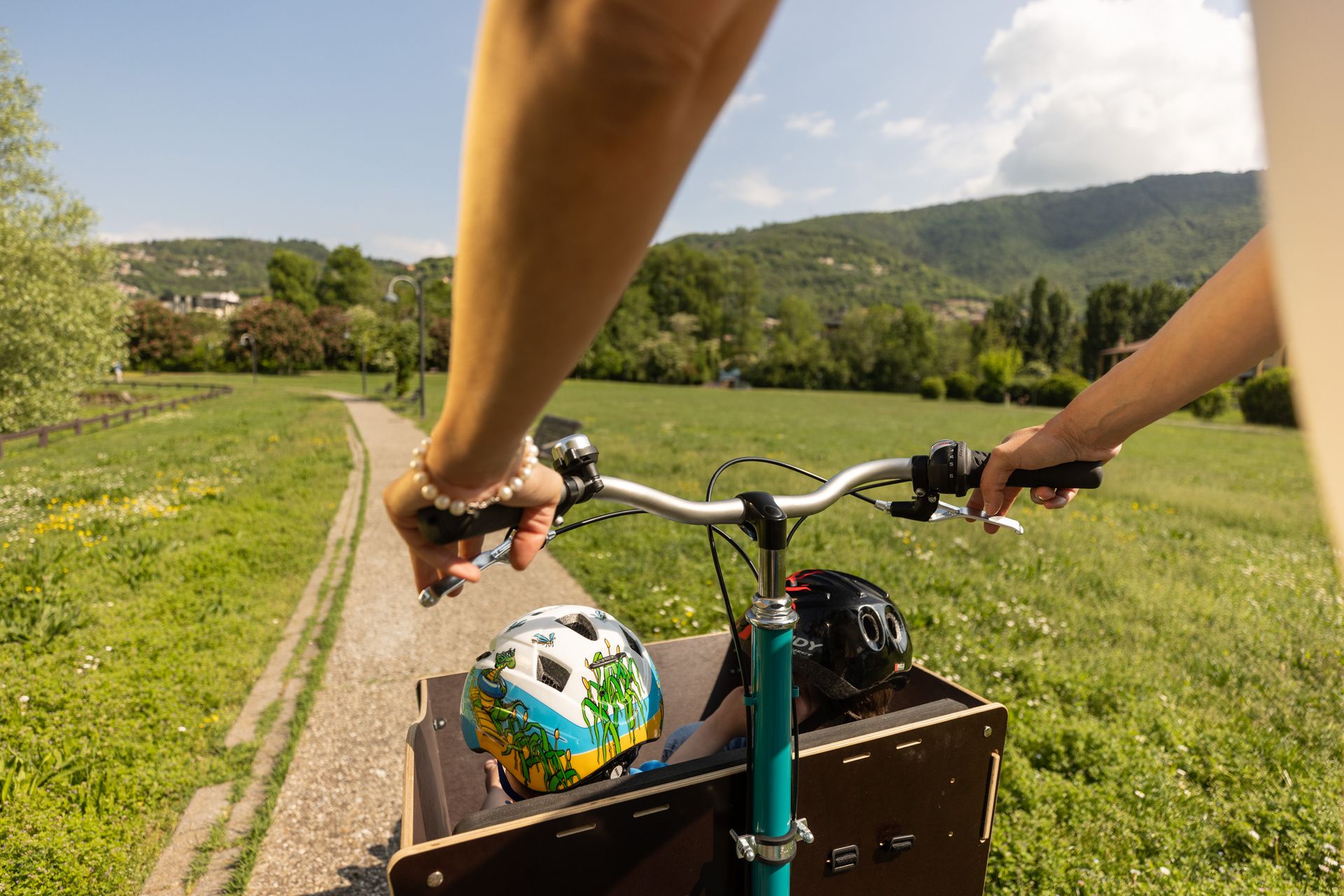
AIDA (High Italy to Cross) is the cycling route designed by FIAB and included in the Bicitalia network, which connects Susa and Trieste for about 900 km, passing through Turin, Milan, Brescia, Verona, and Venice. In the Brescia area, the route crosses the province from west to east, from Lake Iseo to Franciacorta, up to Brescia and Lake Garda.
The entry into the province occurs in the section that connects Bergamo to Brescia (the Culture Cycle Path, about 75 km long, created for Brescia and Bergamo as Italian Capital of Culture 2023).
An itinerary that combines lake, vineyards, castles, abbeys, and cities of art, with some UNESCO sites just a few minutes from the path.
Paratico
Paratico is the first town in Brescia you come across coming from the Bergamo area, where the Oglio River flows out of Lake Iseo.
The bridge over the Oglio connects it to Sarnico and marks the passage between the provinces of Bergamo and Brescia.
From here begins one of the most evocative sections of the entire itinerary, which runs for a few kilometers along the southwestern shore of Lake Iseo.
Clusane
Clusane is a characteristic fishing village overlooking the Sebino River, along the lakeside stretch of the cycle path.
The marina and lakefront offer views of the lake and the mountains on the opposite shore.
Torbiere del Sebino e Provaglio d’Iseo
After leaving the lake, the route climbs along the edge of the Torbiere del Sebino Nature Reserve, one of Lombardy's most precious wetlands, without crossing it: bicycles, even hand-drawn ones, are prohibited in the Reserve.
The Reserve, populated by aquatic birds among reed beds and bodies of water, can only be visited on foot from the entrances of Iseo, Corte Franca and Provaglio d'Iseo.
In Provaglio d'Iseo stands the Cluniac Monastery of San Pietro in Lamosa, overlooking the peat bogs.
We continue towards Borgonato di Corte Franca, already in the heart of the Franciacorta vineyards.
Franciacorta
Franciacorta is the land of bubbles, a landscape of soft hills covered with vineyards, with castles, villas and abbeys.
The castles of Bornato and Passirano and the village of Paderno Franciacorta dot the route.
Rodengo Saiano is home to the Olivetan Abbey of Saints Nicholas and Paul VI, one of the most important monastic complexes in the province.
Numerous wineries offer visits and tastings.
Cellatica
Cellatica is the last town before Brescia, at the foot of the hills that crown the city.
The stretch between Gussago and Cellatica alternates gentle ups and downs and views of the plain.
From here you descend towards the historic centre of Brescia.
Brescia
Brescia is the heart of the Brescia section of AIDA: an art city that offers cycle tourists significant monumental wealth and support services.
UNESCO World Heritage Site “The Lombards in Italy”: The archaeological park of Roman Brescia with the Capitolium and the monastic complex of San Salvatore – Santa Giulia.
The Cidneo hill dominates the city from above with the imposing Castle (the historic and majestic “Falcone d'Italia”), Piazza della Loggia and Piazza Paolo VI with the Old Cathedral and the New Cathedral.
Intermodal hub: Direct connection to Brescia Railway Station, an ideal point for train+bike intermodality.
Desenzano del Garda
Desenzano del Garda is the southern gateway to Lake Garda and the main stop on the final stretch.
The Old Port, the central square and the Castle frame a lively lakefront.
The Roman Villa preserves important mosaics from the late antique period.
Lonato del Garda
Leaving Brescia, the route crosses the plain and moraine hills preceding Lake Garda; Lonato is one of the most interesting stages of the stretch.
The village is dominated by the Visconti-Veneto fortress, which, together with the Casa del Podestà (house-museum) and the Library, is part of the monumental complex of the Ugo Da Como Foundation.
San Martino della Battaglia
A few kilometers from Desenzano, on the moraine hills, lies San Martino della Battaglia, a symbolic place of the Risorgimento. Here, on June 24, 1859, during the Second War of Independence, the Sardinian-Piedmontese army clashed with the Austrian one, on the same day that, a little further south, the Battle of Solferino was being fought.
From the top of the Tower of San Martino, approximately 64 meters high, you can enjoy a wide view of Lower Garda, the moraine hills and the Po Valley.
The birth of the Red Cross: Tens of thousands of soldiers died and were wounded in Solferino and San Martino. Swiss Henry Dunant, present after the clash, was impressed by the assistance provided to the wounded by the population of Castiglione delle Stiviere and recounted the experience in “Un souvenir de Solferino”. From those pages was born the idea of the Red Cross, founded in Geneva in 1863; the Italian Red Cross was established in Milan in 1864.
Recommended deviation: Sirmione
For those looking for an additional excursion, from Desenzano you can reach the Sirmione peninsula by bike, keeping in mind that the historic center is not accessible by bike or scooter. Cyclists should therefore leave their bikes outside the walls and visit the village on foot with the Rocca Scaligera, the Catullus Caves and the spa.