Collegiate Church of Santi Nazaro e Celso
Collegiate Church of Santi Nazaro e CelsoCorso Giacomo Matteotti, 31, 25122, Brescia (BS)
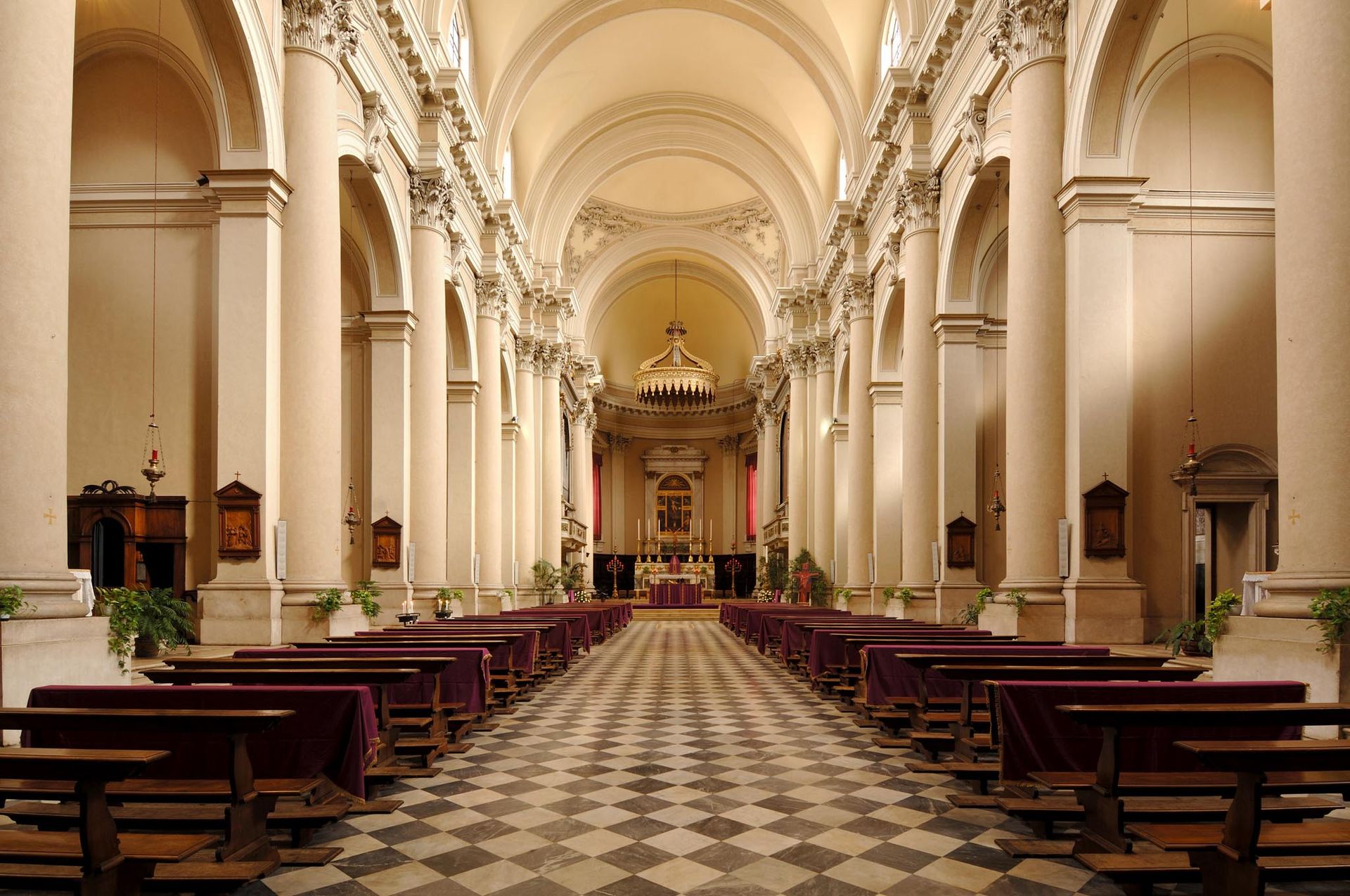
Rebuilt from scratch in the second half of the 18th century by architect Antonio Marchetti, today it’s one of the symbols of Neoclassicism in Brescia. Imposing, elegant, harmonious: it’s one of the largest churches in the city.
The interior houses veritable treasures, but one outshines all others: the Averoldi Polyptych, an early masterpiece by Titian. A work that alone is worth the visit.
The church is located in Corso Matteotti, at the corner with Via Fratelli Bronzetti. A corner whose beauty doesn’t go unnoticed.
THE ARCHITECTURE: A SYMBOL OF RESPECT AND RIGOUR
The façade commands respect: eight Corinthian columns, a triangular tympanum and seven stone saints watching from above. Inside, the church has a single-nave layout with five chapels on each side, a majestic entrance portico and a large presbytery surmounted by an elliptical dome.
The barrel vault runs the full length of the nave, while the apse is concluded by a semi-dome. Corinthian pilaster strips punctuate the walls and support a continuous entablature that leads the eye upwards.
Clean, rigorous architecture that has no need for ostentation to be remembered
THE WORKS: SMALL TREASURE TROVES OF ART
The Church of Santi Nazaro e Celso is a small treasure trove of art. The works, collected and guarded over the centuries by the Chapter, remained intact even after the 18th-century reconstruction.
The greatest treasure is found in the presbytery: the Averoldi Polyptych by Titian, an early masterpiece in five panels. In the centre is the resurrection of Christ, with the saints, angels and patron at the sides. Powerful, balanced, timeless.
The side walls gleam with paintings by Moretto, including the Passion of Christ with Moses and Solomon, with its solemn and didactic tone, and the Coronation of the Virgin with its rich and intense composition. There is also the Adoration of the Shepherds, where the titular saints, Nazarius and Celsus, return as protagonists.
Here, art isn’t just to be looked at. It’s meant to be lived.