From Villaggio Prealpino to Sam Quilleri Park
Where green spaces fight back. And sometimes win.
Where green spaces fight back. And sometimes win.
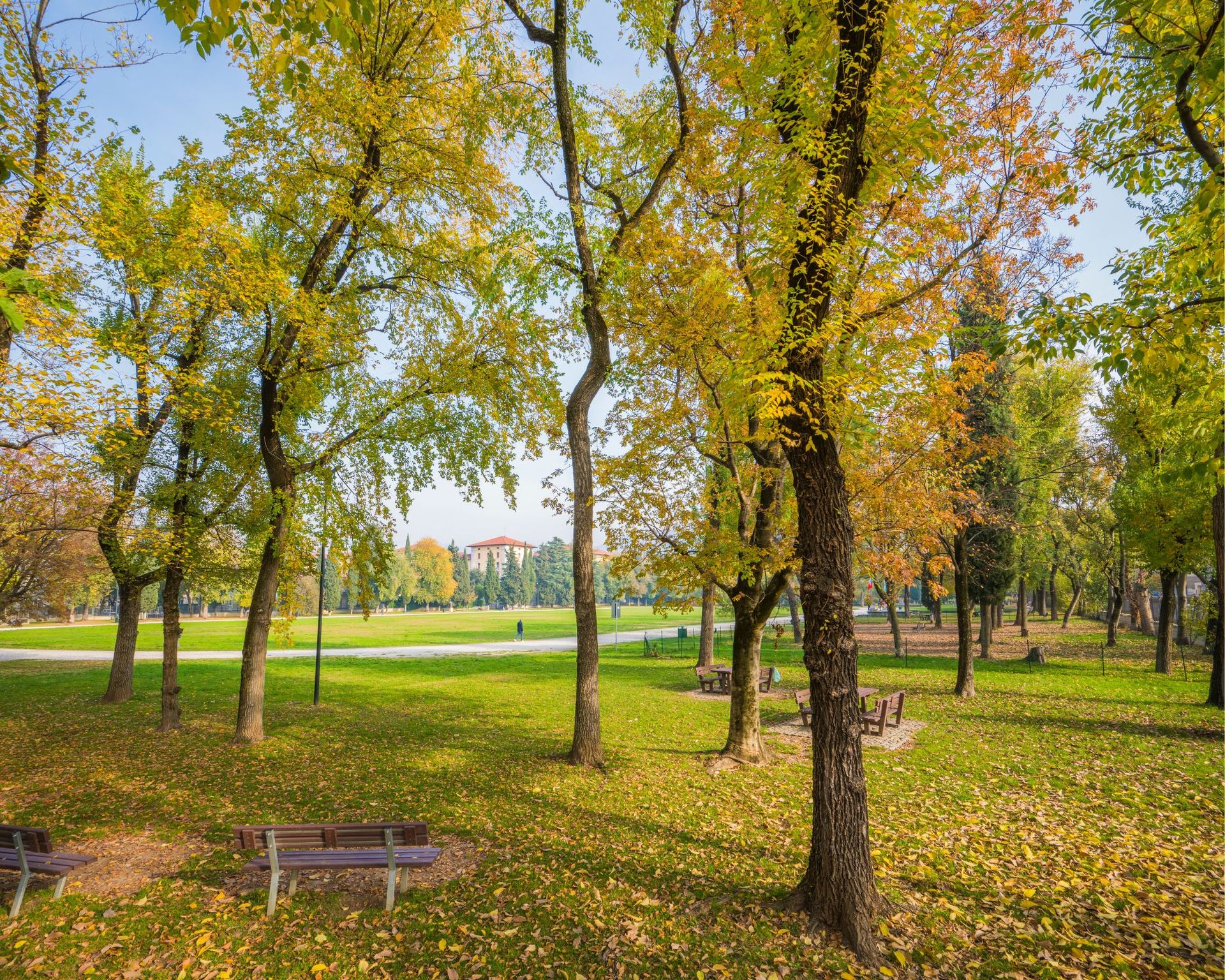
Not all of Brescia’s green spaces are easy to see. Some parks are hidden between houses, others struggle to survive between roads and industrial sheds. This route stitches them together into an urban mosaic of trees, gardens and memory.
You start from Villaggio Prealpino and slip into a strip of city squeezed between Via Triumplina and the Western Ring Road. It’s an area where agriculture survives in small but stubborn pockets, and where another kind of seed is being cultivated: that of urban regeneration.
You continue south through dense but vibrant neighbourhoods. You walk along tree-lined avenues, skirt small parks, cross paths with families, students, dog walkers. You approach the Ori Martin plant area which is not only industry: this is where an urban reforestation project was born, telling the story of a city changing its skin without losing its roots.
Finally, you arrive at Sam Quilleri Park (Campo Marte): a green lung in the heart of the urban fabric, a place where concrete ends and you can finally breathe nature.
Museum of Iron – MUSIL
Where fire met water.
Created inside an old forge, this museum-workshop tells the story of the water wheel and artisan labour. It’s not just about metal and sparks: it’s also a way to read the local area, through ingenuity, hard work and industrial memory.
Murals in San Bartolomeo
Street art that leaves a mark.
In San Bartolomeo, urban art has transformed the face of the neighbourhood. Thanks to the LINK festival, the walls speak: bold colours, direct messages and works signed by international artists. An open-air museum born from the neighbourhoods and aimed straight at the future. And with MAUA Brescia, the experience expands: between Via Svevo, Via Saba and Via Abbazia you can see the works in augmented reality, discovering them on your smartphone as you walk. Download the Bepart app and set off!
Roggia Fiumicella: a small wood that holds on.
Between Parco Marcolini and Ori Martin, just above the Gabbiane area, the Fiume Grande splits and the Fiumicella canal is born. Between the two watercourses, a narrow strip of woodland has survived for at least two centuries. There is black locust here, yes, but also a surprisingly rich undergrowth: in spring you can spot snowdrops, snowflakes, white and yellow anemones. Species that were once common and are now very rare in the city. Here biodiversity makes no noise. But it’s there – and it stands out.
Easy to manage with the metro: Prealpino, Casazza and San Faustino stations are all close to the route. Alternatively, bus lines 10 and 11 serve the area.